TL;DR
Ajax Systems has launched EN54 Line, a fully wireless, EN54-certified fire alarm system targeting commercial and municipal buildings. It replaces cable-heavy traditional installs with QR code device pairing, a touchscreen hub, and app-based management. Installation drops from days to hours, coverage can reach 35 km2, and battery life runs up to 7 years on some devices. It also doubles as an intrusion and automation platform.
What Is It?
Traditional fire alarm systems have not changed much in decades. They work, but deploying them means routing kilometers of cable, wrestling with archaic control panels, and commissioning that takes days. Ajax, already known for disrupting the wireless intrusion market, is applying the same playbook to fire safety with its EN54 Line.
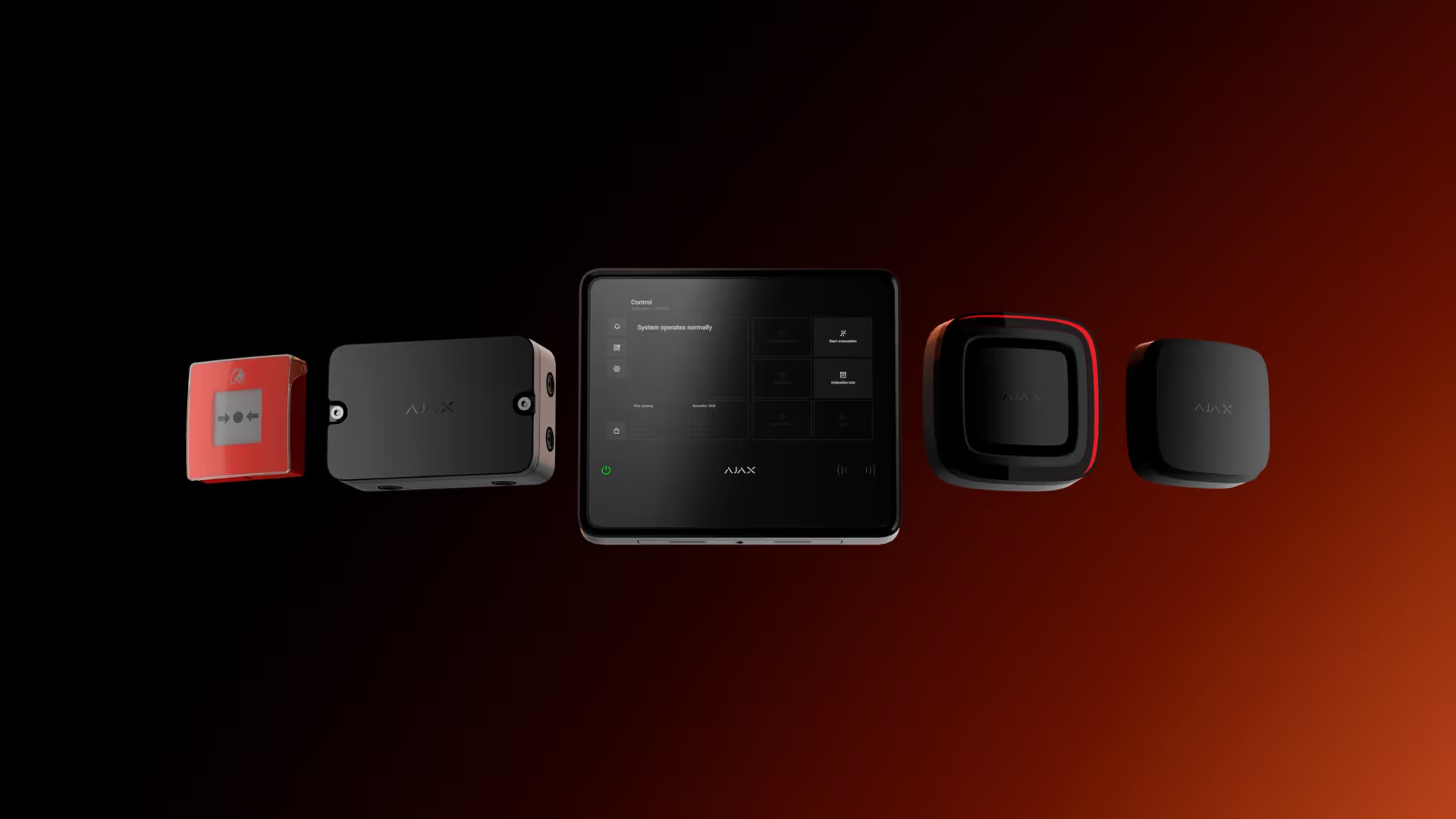
The centerpiece is the EN54 Fire Hub Jeweller: a 10.1-inch touchscreen control unit with built-in Ethernet, Wi-Fi, and dual SIM. No separate communicator needed. It manages up to 200 addressable devices across 40 fire zones, and range extenders (EN54 Fire ReX Jeweller) can push wireless coverage to 35 km2.
Detectors use a patented dual-spectrum smoke chamber (blue and infrared LEDs) paired with the HazeFlow 2 algorithm for fast, accurate detection. Sounders hit 100 dB with 32 selectable tones. Visual alarm devices (VADs) activate in under 3 seconds. Everything is configured via a mobile or desktop app, with no manual programming required.
Advantages
For Installers and Integrators
- No cable routing, bringing installation time down from days to hours
- Each device mounts in around 5 minutes and is added via QR code scan
- Remote configuration, testing, and maintenance through Ajax PRO Desktop
- Firmware updates pushed over the air
- Maintenance reports generated remotely before site visits
For Building Owners and Operators
- Long battery life: detectors and sounders up to 5 years, manual call points up to 7 years
- 24h or 72h backup battery options that are hot-swappable during live operation
- Real-time addressable status on every device, so faults are pinpointed instantly
- Scales from a small retail shop to a hospital or heritage building
- No wall drilling required, which is particularly relevant for listed or protected buildings
For Security and Safety Teams
- Visual alarm verification via MotionCam or IP cameras, with photos and video sent to the app and monitoring station within seconds, reducing false dispatches
- Up to 64 automation scenarios covering evacuation signs, elevator lockouts, PAVA integration, and door releases
- Combined fire, intrusion, and automation in one hub, providing a single platform for comprehensive site protection
- Wireless range up to 1,800 m per hub, extendable via ReX units
Compliance
- Full EN54 certification across the device range (EN 54-2, 3, 4, 5, 7, 11, 18, 21, 23, 25)
- EN 50131 Grade 2 intrusion support built in
Possible Disadvantages
Wireless Reliability Concerns
- RF interference in dense environments such as hospitals or industrial sites could affect signal quality, even with the robustness claims of the Jeweller protocol
- Traditional wired systems have a well-understood failure mode; wireless adds radio as an additional dependency
Regulatory Acceptance
- EN54 certification covers the hardware, but some jurisdictions or Authorities Having Jurisdiction (AHJs) may still require wired systems or have additional local approval processes
- Insurance underwriters in some markets may be unfamiliar with or skeptical of fully wireless fire systems
Battery Dependency
- Batteries are sold separately for the hub, which is easy to overlook in project budgets
- Multi-hundred device deployments mean scheduled battery replacement programs; 5-year cycles sound long until you are managing 300 or more detectors
- Hot-swappable batteries are a plus, but replacements still require site visits
Scale and Cost
- Wireless systems often carry a higher per-device cost than traditional addressable wired detectors
- For very large sites that are already fully cabled, the return on investment case is weaker
- A maximum of 200 devices per hub means larger installations require multiple hubs, with associated management overhead
Vendor Lock-In
- Proprietary Jeweller, Wings, and TurboWings protocols mean all devices must be Ajax; no mixing with third-party fire detectors
- Long-term dependency on Ajax's app ecosystem, cloud infrastructure, and firmware support
Newness Risk
- Disrupting an industry is harder when compliance inspectors and fire officers are accustomed to legacy systems
- A newer product line carries less field-proven longevity data compared to wired systems with 20-year track records
Bottom Line
Ajax EN54 Line makes a compelling case for any project where cabling is expensive, disruptive, or prohibited. The reduction in installation time alone is a significant commercial advantage for integrators. The real test will be how quickly the product earns trust with fire safety authorities, insurers, and facility managers who have relied on wired systems for decades. If Ajax's track record in the intrusion market is any indication, the adoption curve could be faster than the industry expects.